
The Benefits of Vibroacoustic Sound
What happens in the body when sound becomes physical
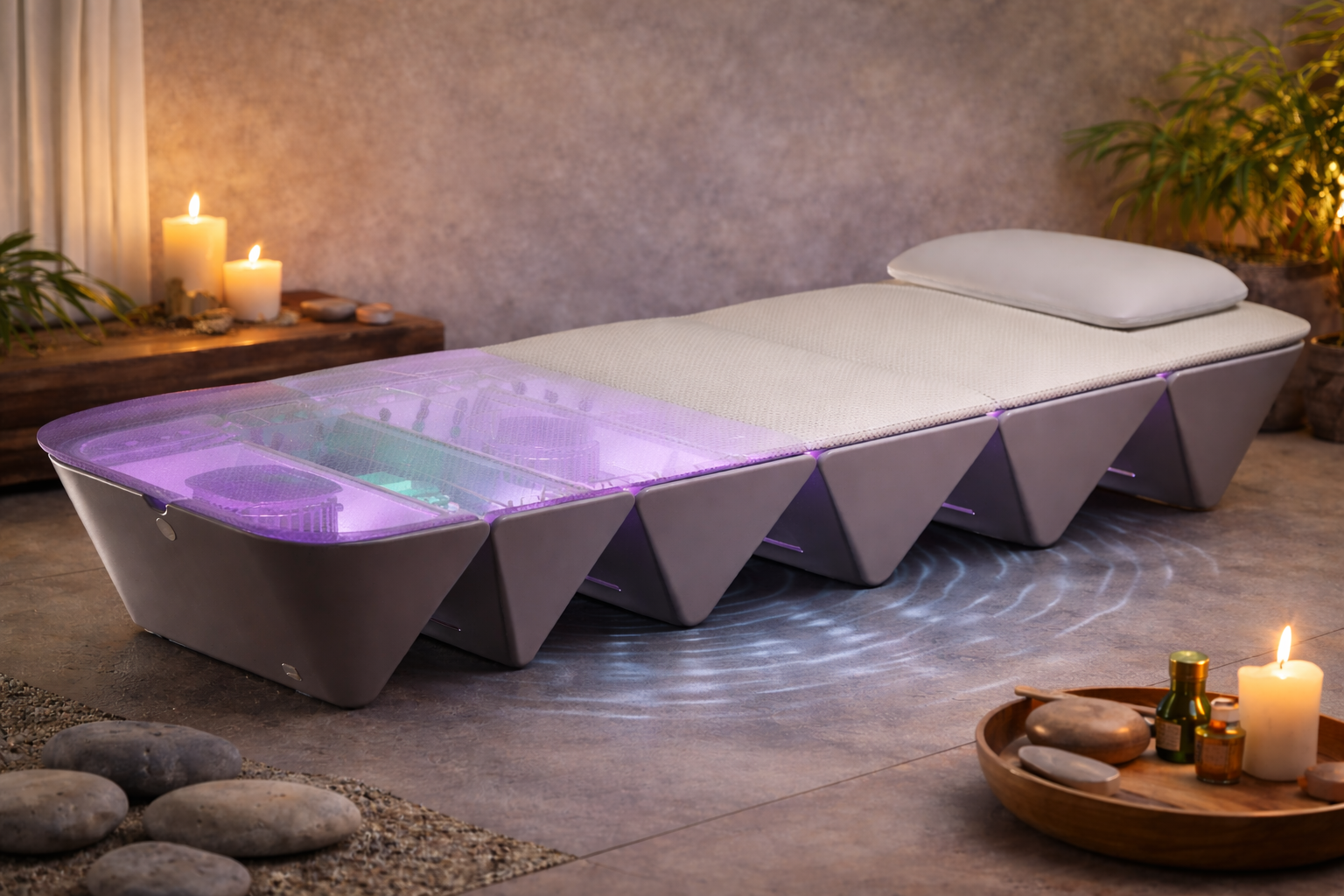
Vibroacoustic sound therapy is often described in terms of technology — sound beds, frequencies, vibration. But what people tend to remember after a session is not the equipment.
They remember how their body felt.
Settled. Anchored. Unrushed.
In a culture that treats healing as something that must be
done, vibroacoustic sound therapy offers something different:
an experience of being
met by rhythm rather than effort.
When the Body Responds Before the Mind
The body is not waiting for instructions.
It responds continuously to input — pressure, sound, temperature, vibration.
Low-frequency sound waves travel through tissue in a way that bypasses interpretation. There is nothing to analyze, understand, or process. The nervous system receives the signal and responds on its own terms.
For many people, this is where the benefit begins.
Not in insight.
Not in catharsis.
But in
settling.
Vibroacoustic sound therapy creates conditions that invite the body out of constant alertness and back toward its natural state of regulation.
Support Without Interpretation
One of the quiet strengths of vibroacoustic work is that it does not require a story.
You do not have to explain what you are feeling.
You do not have to name patterns.
You do not have to revisit experiences.
The body is allowed to receive support without being analyzed.
For individuals who are already thinking deeply, processing constantly, or carrying a long history of “doing the work,” this can feel unexpectedly relieving.
Sometimes care is most effective when it does not ask anything in return.
How Vibration Supports Settling
When sound is felt physically through vibration, the body often experiences:
- a sense of grounding and containment
- softened muscular tension
- a natural slowing of breath
- an increased awareness of physical presence
- a shift from mental activity into sensory experience
These are not dramatic outcomes.
They are stabilizing ones.
And stabilization is often what allows deeper well-being to emerge on its own.
Rest That Is Actively Supported
Many people find it difficult to rest in silence.
The moment things become quiet, the mind takes over.
Vibroacoustic sound therapy offers an alternative kind of rest — not empty, but held. The sound provides a steady reference point that gives the nervous system something to organize around.
This is rest with structure.
Stillness with support.
For some, this makes the difference between lying down and actually settling in.
A Grounded Approach to Subtle Work
In the world of wellness, subtle practices are sometimes framed as mysterious or abstract. Vibroacoustic sound therapy is subtle in a different way — not because it is elusive, but because it is simple.
Sound moves.
The body responds.
No interpretation required.
This makes it especially aligned with grounded, non-directive forms of care. The experience remains yours. The body leads. The practitioner holds the container.
Nothing is imposed.
Nothing is extracted.
Nothing needs to be fixed.
Who This Work Often Supports Well
Vibroacoustic sound therapy is especially supportive for those who:
- feel overstimulated or mentally overactive
- have difficulty settling into rest
- prefer non-verbal forms of support
- want to feel more present in their body
- are drawn to care that is quiet and contained
It is not about transformation.
It is about
re-orientation — back into the body, back into rhythm, back into steadiness.
The Value of Being Met by Sound
In a world that constantly asks us to respond, decide, process, and perform, vibroacoustic sound therapy offers a rare experience:
to simply be met.
Met by vibration.
Met by rhythm.
Met by a steady field that asks nothing of you.
The benefits are not always dramatic.
But they are often deeply felt.
And sometimes the most meaningful support is not what changes us —
but what reminds us how it feels to be settled, grounded, and quietly held.